Current news
Stay up to date with dox42 news, product updates, events, and document automation insights.
Can Document Automation Be Open and Sovereign?
Open Documents, Cloud Sovereignty, and Microsoft Dependencies – How dox42 Supports Public Institutions
Some public institutions in Germany are currently evaluating a shift toward open‑source standards. Instead of Microsoft formats such as DOCX, document formats like ODT can be used. At the same time, ongoing political and regulatory discussions have created uncertainty around cloud sovereignty, data ownership, and potential vendor dependencies.
These concerns come up repeatedly in our conversations with public authorities and institutions. For this reason, we want to clearly and transparently explain how dox42 addresses these requirements – and why choosing dox42 does not introduce an unwanted dependency on Microsoft technologies.
Support for Open Document (ODT)
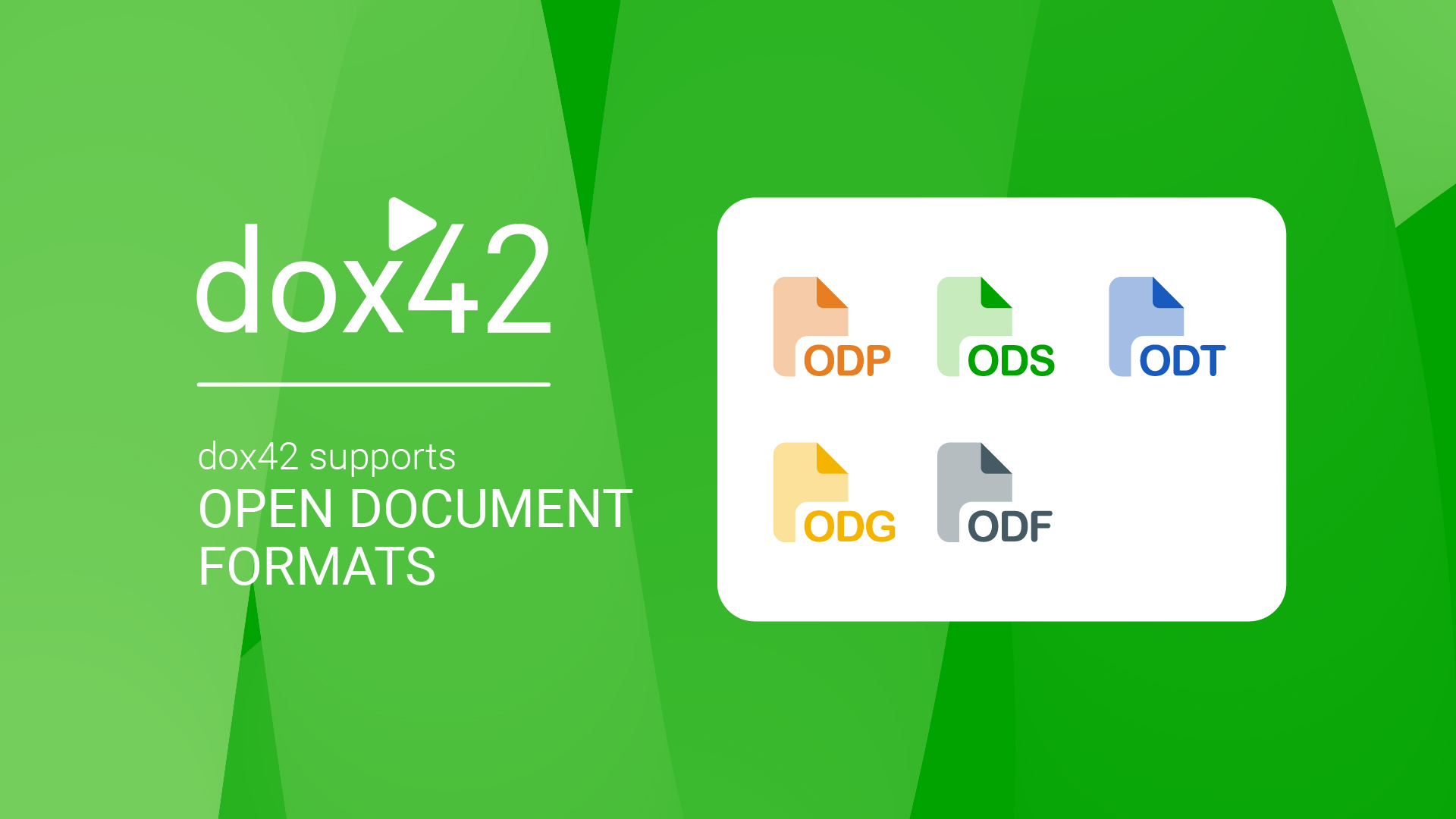
dox42 is not limited to Microsoft formats. In addition to DOCX, XLSX, PPTX, PDF, and others, dox42 can also generate ODT-documents. This allows documents to be created and processed entirely using the Open Document standard – aligning with the IT strategies of many public-sector organizations and the relevant procurement and policy guidelines.
Document generation is just as automated and rule‑based as with other formats. Layout, content, and logic are centrally managed, regardless of the final output format.
In addition, dox42 data mappings are stored in an open and readable XML format. This means that both document templates and data connection configurations are based on open standard formats and can be migrated if required.
Microsoft Office Only Where It Is Actually Needed
Another important point: not all users in a dox42 installation require Microsoft Office.
Microsoft Office is only needed by template designers – the users who create and maintain document templates. In practice, this is usually a very small group, often just 2 to 5 people per organization. End users, case workers, and departmental users do not need an Office installation.
For all other users, document generation takes place via the dox42 web service – fully automated and independent of individual users. This keeps the use of Microsoft technologies limited to a clearly defined and administratively minimal scope.
Flexible Deployment Models and Full Data Control
When it comes to cloud sovereignty, dox42 offers maximum flexibility. The dox42 web service can be operated entirely on‑premises in your own data center. Alternatively, it can be hosted in a European cloud environment – fully aligned with your organization’s security and compliance requirements.
You retain full control at all times over where your data is processed, who has access to it, and under which legal framework the system is operated.
As a result, there is no Microsoft vendor lock‑in – neither technically nor organizationally.
Conclusion
dox42 integrates seamlessly into Open Office strategies, supports open document formats such as ODT, and reduces the use of Microsoft Office to the absolute minimum required. Combined with flexible deployment options, dox42 provides a future‑proof solution for public institutions that value openness, sovereignty, and automation.
News Update Archive
You can subscribe to the dox42 News Update here, or browse through the archive:
dox42 News Update
- Recent releases of dox42
- Success stories
- Practical hints for the use of dox42
- New partners etc.